


27 January 2026
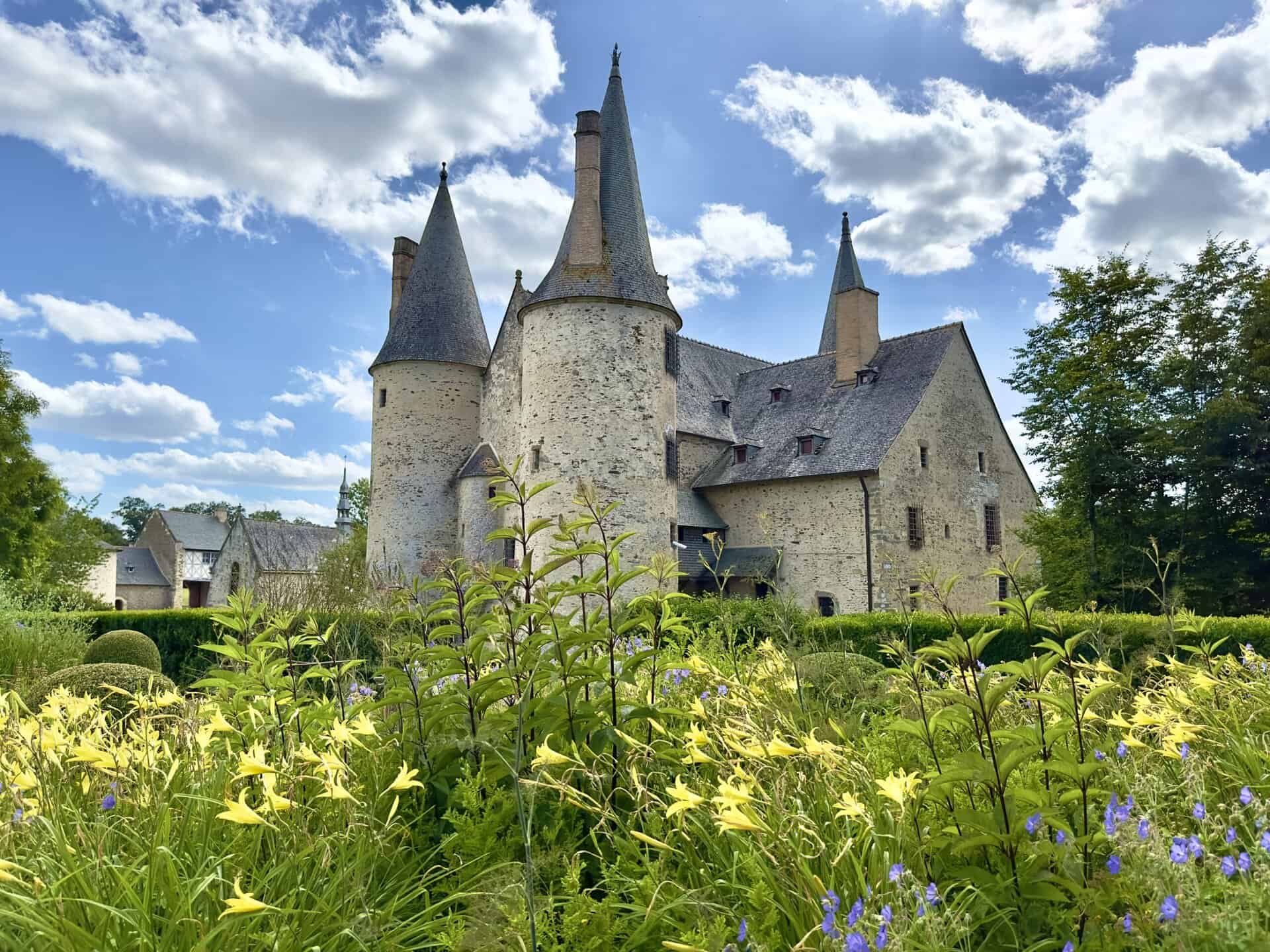
Château de Bois Orcan: A 35-Year Historic Restoration
During the 42nd European Heritage Days on 20–21 September, the Domaine de Bois Orcan reopened its doors to the public on an exceptional basis. Visitors were able to discover, with admiration and keen interest, a remarkable historic monument restoration project that has been unfolding for over 35 years. Our artistic metalwork workshop has naturally been involved in this outstanding Breton heritage project from its very beginnings. Here, we take a closer look at this long-term restoration in detail.

Gaël Hardy, CEO of Crézé, is answering visitors questions on the European Heritage Days 2025
European Heritage Days and Public Engagement
On the third weekend of September, the now well-established European Heritage Days took place across France. Brittany, with its wealth of architectural treasures and historic monuments, fully embraced the event—particularly as this year’s theme focused on architectural heritage.
As part of the programme, the Crézé team was present throughout the weekend at the Domaine de Bois Orcan in Noyal-sur-Vilaine, alongside seven other companies specialising in rare and exceptional crafts. We welcomed visitors, answered questions and presented our work, with a highlight being a live forging demonstration on Saturday afternoon, which we also shared on our Instagram account.

Blacksmithing demonstration by Crézé at the Château de Bois Orcan
A Site Steeped in History
The Château de Bois Orcan is an architectural gem of Breton heritage, dating back to the 14th and 15th centuries. It takes its name from the Orcant family, who first acquired the estate in 1382. The property subsequently passed through several families before becoming the possession of the Thierry family of La Prévalaye in 1475.
In 1520, Julien Thierry—Treasurer to Duke François II and Treasurer-General to Anne of Brittany—undertook major works that gave the château the appearance it has retained to this day. The Thierry family was a prosperous Breton merchant-banking dynasty, influential in both trade and public administration in Rennes.
After changing hands several times, the château was acquired in 1990 by Mr Guy Landon, who remains its owner today. In a 2012 interview with the regional daily Ouest-France, Mr Landon explained that he was seeking “to undertake a historic project, driven by the desire to preserve a place of memory”.
What particularly appealed to him about Bois Orcan was its “history-laden, neglected yet homogeneous character—intact and, above all, unaltered”. A passionate admirer of medieval history, he envisioned the restoration as a long-term, cathedral-like endeavour, gradually unfolding with the ambition of transforming Bois Orcan into a major cultural foundation.
Today, with restoration work nearing completion, the Domaine de Bois Orcan has once again opened to visitors. The site reveals a medieval château dating from the 14th and 15th centuries, an exceptional collection of furniture listed as historic monuments, and an indoor and outdoor museum dedicated to the sculptor Étienne Martin, known as l’Athanor.
A Major Restoration Project
For more than 35 years, the 70-hectare estate has been restored under the direction of Perrot & Richard Architects, notably Alain-Charles Perrot, Chief Architect of Historic Monuments. Projects of this scale require substantial financial resources and often rely on institutional support. In France, state subsidies via the Regional Directorate of Cultural Affairs (DRAC) may cover up to 40% of the cost of works on listed buildings.
The château’s protected status—both listed and registered—ensures that all interventions comply with strict historical, architectural and environmental standards.
This project falls within the scope of conservation-led restoration and has benefited from scientific expertise, including research conducted by building archaeologist Gwyn Merion-Jones and his students. Techniques such as dendrochronology have also been employed to date timber structures, further refining the historical accuracy of the restoration.
To restore this remarkably unaltered site to its former splendour, numerous specialist historic-monument firms were commissioned, including:
• ABC Leroyer (timber framing and roofing)
• Ateliers Perrault (carpentry and fine woodworking)
• Crézé (locksmithing, artistic metalwork and ironwork)
• Galoger (plasterwork, stucco and decorative staff work)
• Heriau (roofing)
• Joubrel (traditional masonry and stone cutting)
• Menuiserie de la Charnie (joinery)
• Malouinières (exceptional colour manufacturing)
The estate comprises:
• the Lower Courtyard, with its gatehouse residence, outbuildings and dovecote;
• the Upper Courtyard, including a chapel and the main château with its towers;
• water-filled moats and a defensive gateway with cannon ports;
• two gardens awarded the Jardin Remarquable label: the medieval Fountain of Life Garden and the Athanor Park, which houses works by Étienne Martin.
Crézé’s Contribution to Bois Orcan
Crézé’s involvement at Bois Orcan has spanned many years, beginning under the direction of Rémi Crézé and continuing through to 2025, ten years after Gaël Hardy took over the company in 2015. Our contributions encompass both exterior and interior metalwork.
Exterior works
Gates and fences
• restoration of 15th-century defensive grilles

Window grids restored by Crézé
• fabrication of two sheet-metal garden gates
• creation of a double-leaf fire-access gate

Double-leaf fire brigade access gate
• restoration and manufacture of defensive grilles for service buildings
• adaptation of historic grilles for pedestrian access
• fabrication of the drawbridge mechanism and ventilation grilles

Invisible mechanical system for raising the drawbridge to access the gardens
Interior works
• manufacture of a handrail for a spiral staircase
• patinated brass cupboard doors
• brass window frames for the Logis and the Foyer

Fixed brass frame Bakery
• bespoke wall-mounted light fittings;
• fabrication of supports for tapestries (including a 15th-century piece), artworks and lighting installations.
It has been both an honour and a pleasure for our teams to contribute to a project that represents a landmark in historic-monument restoration in Brittany—and more broadly in France—allowing us to place our expertise at the service of cultural heritage.
Photo credit: Main photo (at top of article) ©BoisOrcan
-

- Château weathered steel grating
-

- Double-leaf grille
-

- Forged handrail
-

- Sergeant closure system detail
-

- Castle defence grilles
-

- Communal areas: new wrought iron gate